
The Land of Salted Belief
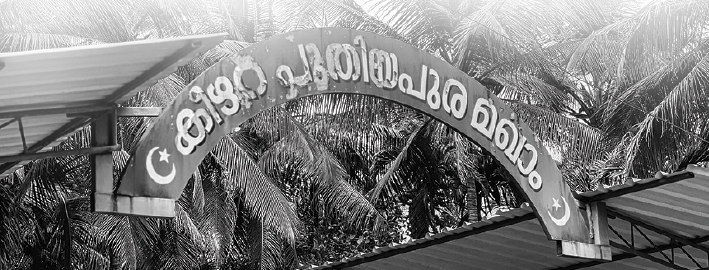
In the quiet corner of Keezhara, history visibly blurs with legend. Our latest field report takes you inside Valiyapura Maqam, a sacred site defined not by grand architecture, but by a unique offering: raw, rugged kallu uppu (crystal salt). Join us as we explore the story of the child martyrs and the community that steadfastly maintains this sensory tapestry of oil lamps, incense, and unshakeable faith.
The private bus from Kannadiparamba hurtled through Kannur’s narrow roads, the engine’s roar filling the afternoon air. My photographer, Zayed, clutched his camera bag as we swerved past the countryside greenery. It was last Friday, shortly after 4:00 PM, and we were chasing a story of salt and sanctity.
Disembarking at Keezhara, the contrast was immediate. We were only ten kilometers from the district headquarters, yet the city's frenetic bustle evaporated the moment our feet touched the dusty ground. It was 4:30 PM. The call for Asr prayers had just concluded, leaving a resonant silence over the landscape. We had arrived at the Valiyapura Maqam.
A Sensory Threshold
Entering the Maqam is crossing a sensory threshold. The atmosphere takes precedence over architecture; the air is thick with the fragrance of burning incense—a heavy, woody scent that clings to your clothes. Zayed immediately began scouting for angles, capturing the late afternoon sun filtering through the trees.
The space is a tapestry of devotion. Walls and grave coverings are adorned with high-quality cloths printed with motifs of Medinah and Mekkah. Local residents move through the space with proprietary pride—they do not visit as tourists, but as caretakers of a shared legacy.
The Mystery of the Crystals
"Watch this," Zayed whispered, pointing toward the entrance.
A young mother stepped across the threshold, looking tired and tightly gripping the hand of a small boy. But it was what she held in her other hand that commanded attention. It was not flowers or money, but a clear plastic bag filled with crystal salt (kallu uppu).
I watched as she approached the designated ledge. This is the defining ritual of Valiyapura Maqam. She did not offer the refined powder found in modern kitchens; she offered raw, jagged crystals. With a silent prayer, she placed the packet among a growing pile of others—a transaction of faith, offering life's basic preservative in exchange for spiritual relief.
The Guardian of the Narrative
To understand this unique ritual, I spoke to Shafeer, the general secretary of the mosque committee. He stood near the adjacent madrassa, formerly a house used for reciting moulid. Shafeer carried himself with an authoritative bearing.
"Many people come here for the spectacle," he said quietly. "But for us, this is a trust."
He was precise about the administrative history: "For generations, this Maqam was under the custodianship of the Kunjarathi family. They were the original keepers. But in 1978, management was transferred to the Muhyudheen Juma Masjid committee. Since then, we have overseen every repair and ritual."
When I asked about the salt and the martyrs, Shafeer’s expression tightened. "The enduring story is of children," he explained. "Martyrs who were not soldiers, but young ones who bravely resisted a local temple in compliance with their mother’s wishes."
He paused, watching Zayed photograph the old oil lamps. "You are a writer, Ameen. You look for dates. But investigations find these stories difficult to verify with paper. Does that make them less real? Look at the salt on that ledge. The respect afforded to these martyrs is unequivocal."
The Living Community
As the sun dipped lower, men began unrolling carpets for the evening. The engagement here is deeply communal. Shafeer mentioned the upcoming Urs, the annual festival on the 22nd of Rabee al-Akhar. "When the Urs comes," he said, "believers come from all across Kerala. That is when you see the true scale of this place’s influence."
We walked toward the perimeter where locals were lighting the traditional oil lamps—a strict daily responsibility. As an elderly man poured oil into a brass vessel and struck a match, the smell of burning wick mixed with the incense.
Reflections at Dusk
As we prepared to head back to the city, I took one last look at the salt packets glistening in the dim light, each crystal holding a silent prayer. Valiyapura Maqam functions as more than a mausoleum; it is a reservoir of collective memory. The story of the children and the mother might be historically hazy. Yet, the validity of the shrine isn't found in a registry. It is found in the hands of the mother I saw earlier, clutching that bag of crystal salt a tangible, rugged offering that speaks of a devotion far deeper and more resilient than the smooth, paved roads we were about to travel back on. The bus back to Kannur would be rushing toward the future, but here, in the quiet corner of Keezhara.