
Spatial Ethics of Kannur Mosques
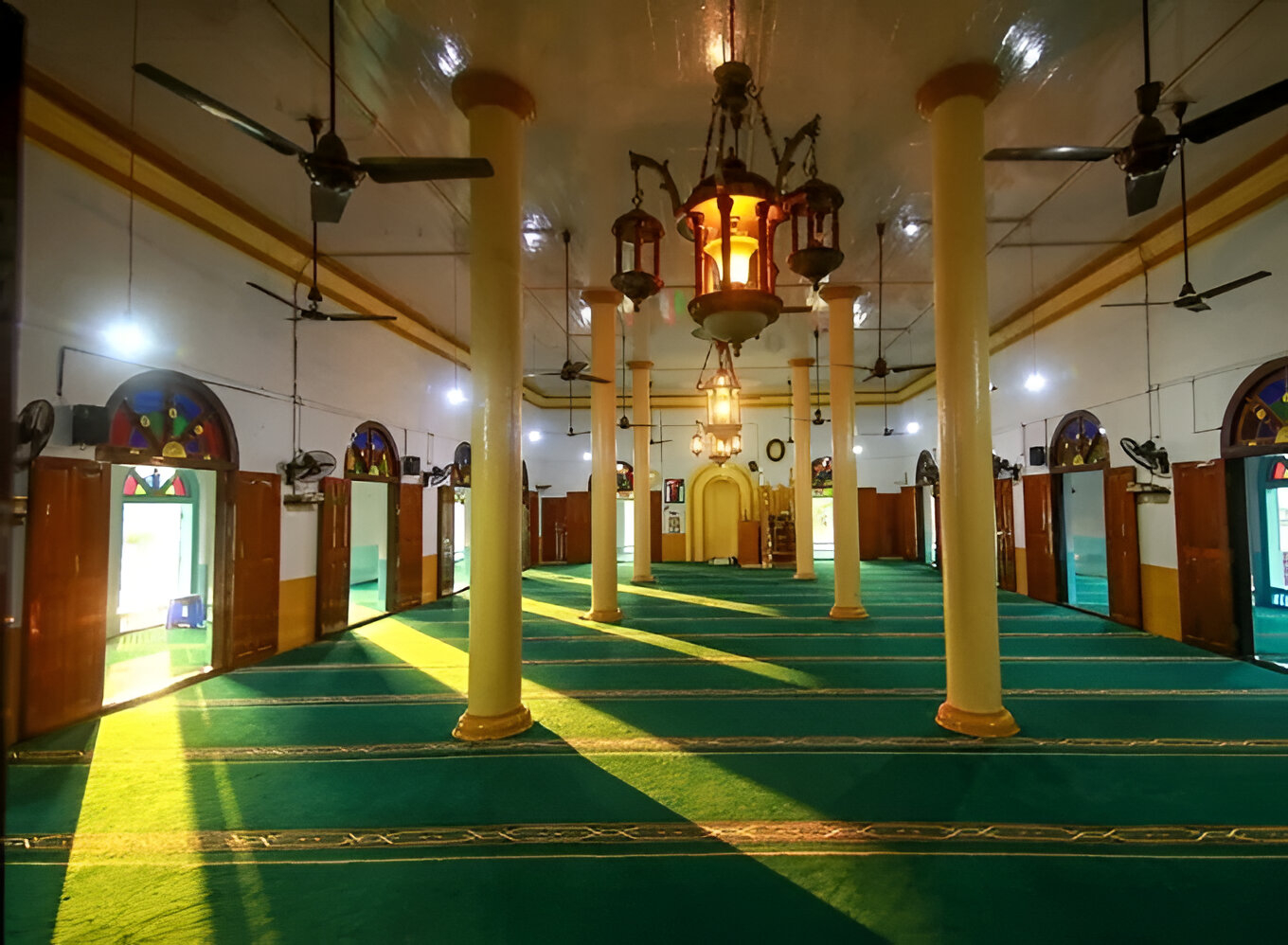
Journeying from the chaotic streets of Kannur to the quiet edges of Thavakkara, this essay investigates the spatial ethics of Kerala’s coastal Islam. Contrasting the street-embedded Labba Mosque with the anchoring Puthiya Islam Mosque, the narrative uncovers a history of migration, trade, and the Arakkal Dynasty. Here, architecture serves as a living archive, resisting domination while fostering community solidarity and enduring coexistence through wood, stone, and shared memory.
The auto-rickshaw lurched from Kannur New Bus Stand, cutting through late-afternoon congestion. Vendors shouted, buses exhaled smoke, and the road—if it still qualified as one—compressed into a corridor of bodies, shops, and faiths. I was heading west, toward Kannur’s older quarters, searching not for a monument, but for a pattern.
At first, nothing stood out. Between concrete houses, textile shops, and aging tiled roofs, the city looked as it always does—dense, restless, multilingual. Then, near a crowded junction, the rhythm shifted. A mosque appeared—not elevated or imposing, but embedded into the street. Wooden shingles lined the roof, oil lamps hung from the eaves, and the boundary between pavement and prayer space remained deliberately open.
This was the Labba Mosque.
A Mosque Without Distance
The mosque did not command space; it shared it. Pedestrians brushed past its walls, motorcycles idled at the entrance, and street noise spilled into the courtyard. This was deliberate, not incidental—an architecture shaped by migration, trade, and adaptation.
The Labbas, who arrived in Kerala after the decline of the textile industry elsewhere, carried more than labor; they brought a cultural grammar. The Arakkal Dynasty—Kannur’s Muslim rulers and Kerala’s only Muslim dynasty—responded by supporting community-based mosques rather than imposing the Janmam–Kanam model, aligning sacred space with social rhythm.
Language no longer carried meaning alone; the mosque itself became symbolic. Watching men pause on the pavement, it was clear this was more than a building. It encoded belonging and collective memory—solidarity rendered in wood and stone.
Dynasty, Trade, and Material Islam
Kannur’s past is not insular. Under sustained dynastic rule, the city cultivated layered connections—particularly with traders from Yemen and Misr—where commerce and politics were inseparable. These relationships did not dissolve into abstraction; they were concretized in space.
Different communities pursued different interests, and the Arakkal rulers responded with architectural differentiation. Mosques became markers of social ecology. Walking through these neighborhoods, I was reminded of Elizabeth Lambourn’s observation that Islamic material culture in coastal South Asia is too often treated as an adjunct to textual history, rather than a source in its own right.
Here, the mosques resisted that reduction. They were not antiquated remnants. They were active archives—holding within them the memory of negotiation, coexistence, and an Islamic ethic that resisted both humiliation and imposed supremacy. Hanging lamps, low roofs, and shared streets testified to an Islam practiced through proximity rather than dominance.
Two Kilometers, Another World
About two kilometers away, the city loosened its grip. The auto dropped me near Thavakkara, where the air felt less compressed and the landscape opened into quieter residential clusters and pastoral edges. The transition was not dramatic, but it was palpable.
The Puthiya Islam Mosque stood there with a subdued authority. Its presence was older, its silence heavier. Unlike the Labba Mosque’s street-level intimacy, this one seemed to gather the community inward. The walls absorbed sound. The courtyard held it.
As I lingered, the mosque revealed itself as a sociological convergence. Weber’s reading of religion as a force structuring community life, Malinowski’s emphasis on religion’s functional role, and Durkheim’s notion of mechanical solidarity all felt less theoretical here. Intangible beliefs had been translated into tangible form—brick, timber, and ritual continuity.
Local accounts trace the mosque back to a period when Kannur witnessed a cumulative wave of Muslim conversions. This was not a moment of rupture but of gradual alignment, and the mosque bore the marks of that history. It was not built to differentiate, but to anchor.
Closing Notes
As dusk approached, lamps were lit—one by one—casting soft halos against the aging walls. Children played near the entrance, their voices folding into the call to prayer. Nothing here felt staged. Nothing felt frozen in time.
These community-based mosques, scattered across Kannur, stand poles apart from standardized religious structures. They counter centrifugal forces—demoralization, intramural fracture, communal disparity—not through rhetoric, but through spatial ethics. In their modesty lies their power.