
The Street of Jahanara Begum Has Many Stories to Tell
The life of Jahanara Begum is rich with stories. Born on the 23rd of Safar, Hijri year 1023, Jahanara
Begum was the daughter of Emperor Shah Jahan. She grew up as a distinguished scholar with deep
interests in religious knowledge and literature. Her command over Persian and Arabic languages set
her apart from others.
When her mother Mumtaz Mahal passed away, half of her wealth was given to her most beloved
daughter, Jahanara, while the remaining half was distributed among the others. At just 17 years of
age, adorned with all royal honors and grandeur, Jahanara Begum was chosen as the Badshah
Begum of the empire.
After Mumtaz Mahal’s death in 1631, the title Sahibat-ul-Saman came to Jahanara. As the owner of
the Surat port, the princess deployed her ship Sahibi to transport goods and pilgrims between Surat
and Mecca. The income from the port made Jahanara immensely wealthy. In 1648, she bore the
entire expense of constructing one of India’s largest mosques — the famous Jama Masjid in Agra. As
a mark of respect to her spiritual guide, Mulla Shah, she also built a mosque in Srinagar in 1650.
Following Mumtaz’s death, Jahanara became Shah Jahan’s chief political diplomat. Having risen to
the position of Malika-e-Hindustan Badshah Begum at the age of 17, her decisions were given great
importance by the emperor in matters of governance. However, she could not bring a resolution to the
power struggle between her brothers. Though she tried to reconcile Aurangzeb and Dara Shikoh, she
ultimately witnessed Aurangzeb seize power after killing his brother.
When Shah Jahan was imprisoned in Agra Fort, Jahanara Begum renounced all royal comforts and
chose to live with her father in captivity. After Shah Jahan’s death, Aurangzeb brought her back to
Delhi with full honors and restored her title of Badshah Begum.
Jahanara Begum passed away on the 3rd of Ramadan, Hijri year 1092. Her grave lies beside that of
Hazrat Nizamuddin Auliya, still resting there today, gently touched by the rosewater sprinkled by
devotees over the years.
Fatehpuri Masjid
While building his city in 1650, Emperor Shah Jahan had one of his wives construct this mosque at
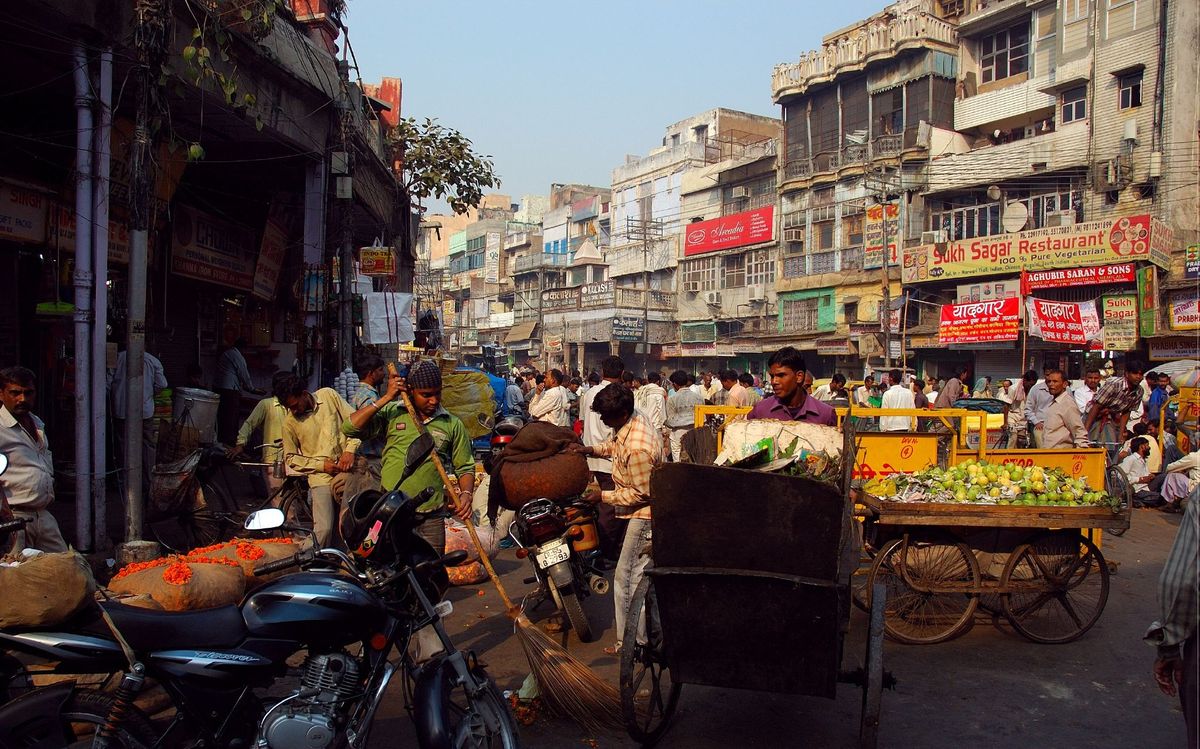
one end of Chandni Chowk. Though the entrance of the mosque opens toward the bustling Khari
Baoli market, the moment one steps inside, an overwhelming sense of peace takes over.
As you enter the courtyard, the first thing that catches your eye is the beautiful white dome adorned
with long green lines. Built with red sandstone and later polished, the dome gleams from afar like
white marble. This is the only mosque from the medieval period built with a single dome. On either
side of the dome stand two minarets, each about 80 feet tall.
During the Revolt of 1857, Fatehpuri Masjid was used by revolutionaries for shelter and medical
treatment. After the fall of Delhi, British troops occupied the mosque. Later, the British government
seized it and auctioned it for 29,000 rupees to a trader named Lala Chunnamal. At the time, Muslims
who had been scattered after the rebellion lacked the financial means to buy it back.
Years later, after Muslims formally apologized for their role in the uprising, they were permitted to re-
enter Shahjahanabad. In exchange for four villages given to Chunnamal, the British government
returned Fatehpuri Masjid to the Muslim community.
Jahanara Begum Ki Sarai
Built in 1650 in Chandni Chowk, Begum Ki Sarai was considered one of the most beautiful
caravanserais in India at the time. It can be said that the emperor’s beloved daughter tried to preserve
her memories through this structure.
Spread across 186 feet of land, the sarai had two massive gates — one opening southward to
Chandni Chowk and the other northward toward Begum Ka Bagh (the princess’s garden). The two-
storied structure contained a total of 90 rooms. After 1857, the British army demolished the sarai.
Chandni Chowk: The Street of Jahanara Begum
One of the most beautiful marketplaces in the world, Chandni Chowk was designed by Jahanara
Begum in AD 1650. As Sir Syed Ahmad Khan once said, its beauty is beyond description. Every
section of Chandni Chowk was designed with extraordinary elegance.
It can be said that there was nothing in the world that could not be bought on this street. In his book
Shahjahanabad: The Sovereign City in Mughal India, historian Stephen Blake writes that the market
was octagonal in shape, about 100 yards long, with a pool at its center. Jahanara built a sarai and
garden on the northern side and a bathing pavilion on the southern side.
On full-moon nights, the moonlight would reflect in the central pool and spread across the street.
Because of this shimmering sight, the pool was named Chandni Chowk (Moonlit Square). Gradually,
the entire market — from Lahori Gate to Fatehpuri Masjid — came to be known by the same name.
The symbols of Muslim rule continue to shape India even today. Though many were destroyed during
British rule, some still survive as sacred remnants of history. Each of them has a thousand stories to
tell. If we only listen to those stories, they may well hold the solutions to many of contemporary India’s
problems — without a doubt.