
The Usurpation of the Centre: The Shift of Glosses into Canons
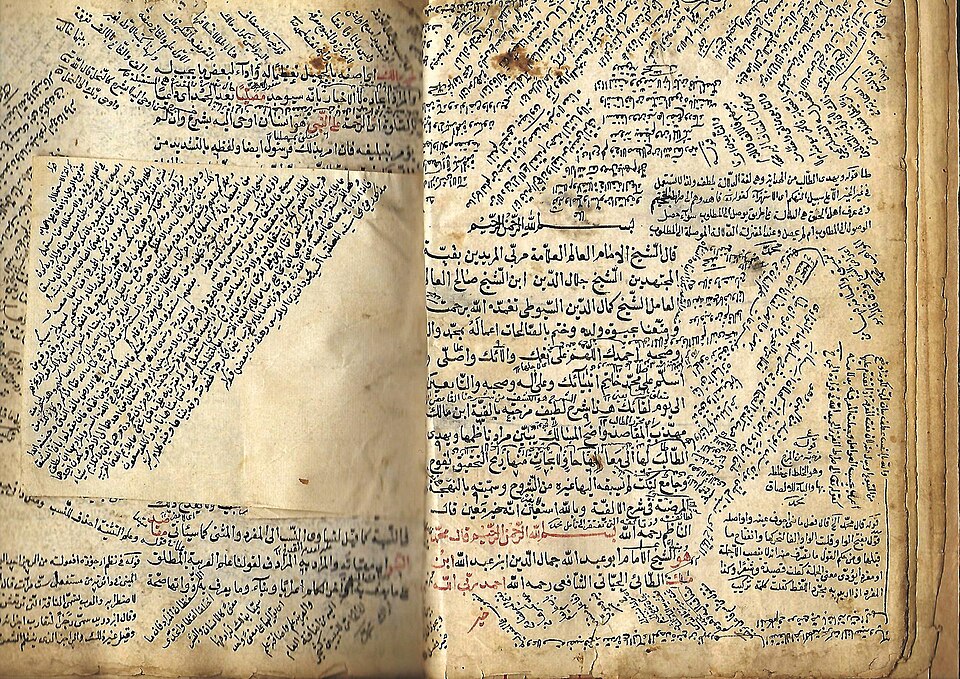
Kitābization of Marginalia in the Islamic Scholarly Tradition
The history of Islamic intellectual tradition is often misread as a static collection of foundational monographs. The marginalia, termed as Taʿlīqāt or scholarly annotations, hold a significant position that actively emerged in the 7th CE AH and is undergoing extensive discussion in academia. It goes without saying that there is a long-entrenched tradition in the scholarly world in which Sharḥs, Ḥāshiyas and Ḥawāmish are jotted down for various books in Islamic studies that have been authored since the classical Islamic period. Afterwards, Taʿlīqāts are continuously written for each of such commentaries, books and marginal notes. Today, we're living in a time where studies exclusively committed to these Taʿlīqāts are proliferating and expanding significantly. Traditionally, scholars in various fields authored books, and other scholars would later make corrections, record istidrakāts, rectifications, or other insights in different forms as Taʿlīqāt on those works.
Kitābization is the process by which marginal commentaries and glosses were transformed into independent scholarly works. The Taʿlīqāt and the Ḥāshiya tradition denoted the jottings, lecture notes, and annotations that a master either recorded privately or dictated to disciples. Yet, the history of Arab-Islamic intellectual tradition and culture is replete with instances where these margins were reviewed, transmitted, and canonized as independent works in their own right. Despite its far-reaching influence, Kitābization has received sufficient and adequate attention in the secondary literature.
The term Taʿlīqāt derives from an Arabic root meaning 'to hang' or 'to attach'; terminologically, it signifies a text suspended from another discourse. In the early Islamic period, the taʿlīqāt was closely associated with the dictation of a master so that he would dictate his additional comments, and the disciples would record them in terms of Taʿlīqāt in their notes. These annotations are known by various terms like Hamish, Taʿlīqāt, Turra and Ḥāshiya, which philologically refer to notes placed on or beyond the margins. Linguistically, ḥāshiya refers to the side or outer edge, derived from the verb ḥashā, meaning to be on the side. The scholia, marginal commentaries, offer a wealth of information, as it is a crucial part of the development, transmission, and compilation of different genres. Those marginalia and glosses provide evidence of the popularity of texts at a given time. And in fact, super glosses and marginal commentaries can reveal popular, private, and persuasive thoughts of the author. These glosses allow us to reconstruct the author's work alongside its form, reception, and model, and to redefine a reader's engagement with a specific text through both critical and analytical remarks.
The Evolution into Independent Works
The transformation of Taʿlīqāt into independent books or Kitābization has been largely affected by the educational revolutionary movement during the post-classical period, as the original texts became unfamiliar and the Taʿlīqāt's and Ḥāshiya became integrated into every field of study. And one of the most profound ways a Taʿlīqāt became an independent book is through synthesis. Some glossators used the marginalia to collect, compare and to make official decisions between dozens of opinions from various schools of thought, in a way that they can cover a vast area of topics even from one text.
The most visible driver of Kitābization is the development of ḥāshiya-ʿalā-ḥāshiya in the commentaries rather than the original text or matn. But in the study of legal theory or Uṣūl al-fiqh, the original text might be only a few pages long, while the extensive super-commentaries around it evolved into multi-volume works and developed as independent works. Because the core text (matn) was highly condensed, it only provided a foundational framework, leaving the comprehensive descriptions to the commentators and glossators.
The historical presence of Ḥāshiyas itself shows many modern Quranic copies, like the edition of a renowned Indian scholar, Shaykh Aḥmad ʿAlī Sahāranpūrī, that contain intensive and comprehensive glosses detailing the Rasm or orthography of the Quran, and the different accents of qira'ats. Yet this type of extra-textual material in mushafs was discouraged by some scholars. In Arabic lexicography, glosses or marginalia are treated as legitimate sources of linguistic matters.
The Ḥāshiya tradition in Islamic fields, like Tafsir works are evident such as Tafsīr al-Kashshāf ʿan Ḥaqāʾiq al-Tanzīl wa-ʿUyūn al-Aqāwīl fī Wujūh al-Taʾwīl by al-Zamakhshari and Anwār al-Tanzīl wa-Asrār al-Taʾwīl by al-Bayḍāwī. The renowned Ḥāshiyah al-Shaykh Zadah originated as marginal footnotes written by the author Muḥyī al-Dīn Shaykh Zāda, who wrote glosses and marginal footnotes on the sides of the base text, so that it is highly regarded as a scholarly commentary on Tafsir al-Bayḍāwī, which is one of the most famous and widely studied explanations of the Quran in the Islamic world. We can find an example of a small gloss upon it, as the Shāfiʿī scholar Zakariyyā al-Anṣārī also had a commentary upon al-Bayḍāwī, which is titled in Fatḥ al-Jalīl bi-Bayān Khafiyy Anwār al-Tanzīl, as the title itself indicates that it elucidates the hidden matters of the base text. More than twenty taʿlīqāt are recorded for Tafsīr al-Bayḍāwī alone. Among the notable scholars engaged with this tradition, Raḍī al-Dīn Muḥammad ibn Yūsuf, known as Ibn Abī al-Luṭf al-Qudsī, produced a combined study of Tafsīr al-Bayḍāwī, al-Kashshāf, and Tafsīr Abī al-Suʿūd, composed during his period of study under his master — a vivid example of the pedagogical origins of taʿlīqāt.
In the field of ḥadīth, the trajectory of kitābization is equally striking. It is evident that Kitabs such as Fatḥ al-Bārī bi-Sharḥ Ṣaḥīḥ al-Bukhārī of Imām Ibn Ḥajar al-ʿAsqalānī, widely regarded as a preeminent authority and the first to show his expertise in ʿulūm al-ḥadīth and honoured with the title Amīr al-Muʾminīn fī al-Ḥadīth, began his engagement with al-Bukhārī's Ṣaḥīḥ through a series of taʿlīqāt and partial annotations, as we can see the spotlight of the glosses. The Fatḥ al-Bārī itself, over twenty volumes in modern editions, represents in fact, the presence of Kitābization. It is more obvious that by the 18th and 19th centuries, the Ḥāshiyas reached their zenith in the six canonical hadith collections. The polymath of Islamic studies, Jalāl al-Dīn al-Suyūṭī, titled the Compiler of genius, wrote commentaries on all six Canonical Hadith books. Qāḍī ʿIyāḍ’s Ikmāl al-Muʿlim bi-Fawāʾid Muslim represents an exemplary case of multi-stage Kitābization in the Ḥadīth tradition. Its textual origins lie in the Muʿlim bi-Fawāʾid of al-Māzarī, which was itself an annotated commentary derived from earlier marginal scholarship.
Nowhere is the centrality of the ḥāshiya and taʿliqa more evident than in the domain of Islamic jurisprudence (fiqh). The authoritative works of Imām Yaḥyā ibn Sharaf al-Dīn al-Nawawī and Imām Shams al-Dīn al-Ramlī generated extensive layers of super-commentary. The later scholars following the matn of previous scholars wrote to break the shackles of Fiqhi riddles, tough masa'il, through the glosses and super-glosses. The later Shāfiʿī tradition of Egypt produced a dense network of ḥawāshī on the texts of al-Khaṭīb al-Shirbīnī's Mughnī al-Muḥtāj, and Zakariyyā al-Anṣārī's Fatḥ al-Wahhāb. Among these, the Ḥāshiyat al-Bujayrumī ʿalā Sharḥ al-Khaṭīb by Sulaymān al-Bujayrumī, and Ibrāhīm al-Bājūrī's Ḥāshiyat al-Bājūrī ʿalā Sharḥ Ibn Qāsim underwent a particularly visible Kitābization. Originally marginal glosses on existing commentaries, they were printed as independent volumes in the nineteenth and twentieth centuries, complete with their own indices and tables of contents, and are today universally treated as stand-alone kutub in Shāfiʿī legal education. There is a vast area of the Fiqh corpus that shows the profound impact of Kitābization in the Islamic Academia.
The commentary tradition on Ibn Mālik's Alfiyyat Ibn Mālik — formally titled al-Khulāṣa al-Shāfiya al-Kāfiya and composed in a roughly 1,000-line poetic structure (precisely 1,003 lines) — witnessed an extensive corpus of ḥāshiyas and taʿlīqāt, including Sharḥ Ibn ʿAqīl, Sharḥ al-Ashmūnī, Manhaj al-Sālik fī al-Kalām ʿalā Alfiyyat Ibn Mālik by Ibn Ḥayyān al-Andalusī, and al-Durra al-Muḍiyya by his son Badr al-Dīn Muḥammad, known as Ibn al-Nāẓim in recognition of his expertise in his father's discipline. The most celebrated commentary, Sharḥ Ibn ʿAqīl ʿalā Alfiyyat Ibn Mālik, itself attracted further glosses, including Ḥāshiyat al-Khuḍarī and Ḥāshiyat al-Ṣabbān upon Sharḥ al-Ashmūnī. Al-Suyūṭī's marginalia on the Alfiyya, titled al-Bahja al-Mardiyya, subsequently became an independent text — a quintessential instance of kitābization. In the syntactical tradition, the work titled Talīq al-Farāʾid by Muḥammad ibn Abī Bakr ibn ʿUmar al-Damāmīnī stands as a notable early instance of a taʿliqa operating as an independent scholarly text. Al-Bakūra al-Shahiyya by Ẓafar al-Dīn al-Lāhūrī likewise represents a marginal gloss upon the Alfiyya that assumed independent standing.
In the domain of Islamic theology, al-Taftāzānī's Sharḥ al-ʿAqāʾid began as a set of explanatory taʿlīqāt upon the highly concise base text, al-ʿAqāʾid of Abū Ḥafṣ Najm al-Dīn al-Nasafī. Al-Taftāzānī's annotations were subsequently transformed into an independent work that was incorporated into the curricula of later institutions, demonstrating how the pedagogical origins of taʿlīqāt could give rise to texts of enduring canonical status.
Regional Influence
The spread of taʿlīqāt was not confined to Arab or classical Islamic subjects; the tradition made significant inroads into the Indian subcontinent and into Keralite scholarly works. The Indian model of Islamic sciences accorded especial prominence to ḥadīth studies, and this is reflected in the glosses produced for the six canonical collections. Majma'u bihar-al-Anwar fi Gharaib al-Tanzil wa Lataif al-Akhbar of Shaikh Muhammed Tahir al-Fathni Al-Hindi, as the kitab Taʿlīqāt itself stands at the position of the whole six canons. The marginalia written in the commentary of Aun-al-Ma'bud and Badl al-Majhud saw the immense proliferation of margins and glosses regarding the Lataif and linguistic matters.
The history of Shafi’i jurisprudence in the Indian Ocean littoral, particularly in Kerala, Southeast Asia, is linked to Fath al-Mu'in bi Sharḥ Qurrat al-'Ayn of 16th-century Keralite polymath Sheikh Zainuddin Makhdum II of Ponnani. The text itself represents the first step in the layered tradition of Islamic commentary as he first wrote the highly condensed core text matn titled Qurrat al-'Ayn bi Bayan -i-Muhimmat al-Din, and subsequently authored its auto-commentary, Fath al-Mu'in bi Sharḥ Qurrat al-Ayn. The acceptability of jurists for this matn and sharḥ produced an extensive corpus of super-commentaries, ḥāshiyas and marginal notes taʿlīqāt. This process perfectly exemplifies the Kitābization of marginalia, where private jottings, corrections, and dictations evolved into massive, independent, and authoritative multi-volume works. Some of the notable glosses are below:
Ḥāshiyat I'anat al-Talibin by Sayyid Bakri Shata al-Makki
Abu Bakr bin Muhammad Shata al-Dimyati al-Makki’s I'anat al-Talibin 'ala Halli Alfaz Fath al-Mu'in is the most globally recognized and authoritative super-commentary on the text.
Ḥāshiyat I'anat al-Musta'in by Ali Ba Sabreen
Authored by the eminent scholar Ali bin Ahmad Ba Sabreen, I'anat al-Musta'in is another critical layer of commentary. Glossators like Ba Sabreen actively used the margins to clarify the Rujhan preferred rulings within the school, demonstrating how marginalia functioned to formalize legal interpretation.
Tarshih al-Mustafidin by Sayyid Ahmad bin 'Alawi al-Saqqaf
Sayyid Ahmad al-Saqqaf's Tarshih al-Mustafidin bi Tawsheeh Fath al-Mu'in is intertwined with the Meccan-Hadhrami-Keralite scholarly nexus as it also gave the critical rectifications istidrakāt to the Kitab.
Tanshit al-Mutali'in by Ali Ahmad Naqshabandi (Kunjutti Musliyar)
As a Ḥāshiya, it reflects the pedagogical needs of the region, clarifying difficult passages and contextualizing the jurisprudence for local students, thus cementing Fath al-Mu'in's centrality in the subcontinent's Shafi’i'i curriculum.
Karingapara Taʿlīqāt by Muhammed Bin Sufi Al-Karingapari
The existence of the Karingapara Taʿlīqāt tells us that the margins of Fath al-Mu'in were highly active spaces where Indian Ocean scholars continuously negotiated and refined intellectual authority. The copies of Fathul Muin in the Keralite coasts were exchanged and handed over, with the copy along with the Taʿlīqāt of Karingappara Muhammed Musliar.
Beyond the realms of jurisprudence and hadith, the phenomenon of extensive marginalia taking on independent authoritative life extended deeply into classical devotional literature and, in particular, Mada'ih Nabawiyya. A prominent example of this in the South Asian context is Al-Qasida al-Witriyya fi Madh Khayr al-Bariyya, authored by Majd al-Din Muhammad bin Rashid al-Baghdadi. The poems are structured in the Arabic alphabet, where every letter contains 21 baiths, and the letter Meem contains 22 because it is the starting letter of the Prophet Muhammad (PBUH), as the poet decided to show his prophetic love. The poem was celebrated for its immense linguistic complexity and profound spiritual admonitions.
In the pedagogical networks of the Malabar Coast, the most vital addition to this corpus is the Taʿlīqāt of the Keralite scholar Miran Kutty Musliar, as he utilized the margins of this devotional poem to perform rigorous linguistic decoding. His Taʿlīqāt meticulously unpacked al-Baghdadi’s rare vocabulary, complex syntax, and theological allusions, effectively transforming a poetic work of devotion into a rigorous textbook for Arabic grammar and rhetoric. He also provided meanings in the Arabic-Malayalam language.
Notable Compilations and Scholarly Debates
Verily, the transformation of glosses into independent books, in terms of Kitābization of Taʿlīqāts, showcases the growth and development in intellectual authority, where the marginal or the paratexts became manual and independent authority. So that we can understand how the Ḥāshiya and Taʿlīqāt moved from the marginal gloss or sides to the center of a scholarly curriculum. The provision of Taʿlīqāts has been a great habit of scholars who have gained mastery in their fields. Although no more independent works have been found in this area, the modern renowned scholar Abdul Fattah Abu Gudda discusses this matter in the latter part of his well-known masterpiece: Qimat al-zaman 'ind al-ulama, as he titled the portion, Abyatun Nafisa min Kutub, indicating his intention to bring forth poems containing invaluable knowledge that he found while reading various books. As an introduction to the poem, he states that the provision of Taʿlīqāts was a habit of later scholars. He denotes the function of Taʿlīqāts, a correction of mistakes in the books, providing additions (Idafat) for further clarification, Tawdih or making clear the tricky matters, sharing rare wisdoms or recording poems containing profound ideas. Regarding the long habit of writing numerous Taʿlīqāts, He points out that if we were to compile such Taʿlīqāts scattered across various books into a single volume, it would be one of the greatest contributions that we could make to the Islamic world of knowledge.
He then speaks about a scholar who engaged in this field, al-Wazir Jamaluddin al-Qifti, who was a scholar-ruler who made tremendous contributions to the intellectual world. Born in 568 AH, he was a historian and a thinker who demonstrated profound expertise in several subjects. Although he served officially as a Qadhi during the reign of the renowned ruler Malik al-Zahir. He had a lifelong habit of collecting books and maintaining them, as his personal library was a container of books worth 50,000 dinars. Because of this, he didn't even own a house to live in, as it is often said that he was a great man who married knowledge.
Nuzhatul Khatir made a massive contribution to al-Qifti by compiling these Taʿlīqāt to form a new book. The title itself speaks about the significance of containing invaluable collections capable of broadening the intellectual horizon of any human being. Another scholar who proceeded in a similar manner was Jameel Mustafa al-Azm, renowned as al-Adib al-Areeb, who spent his life in Damascus and was a well-educated person who authored a specific work titled al-Zubabat, a compilation of what he found in his educational journey through Taʿlīqāts written on margins and covers of various books. It is said that if we refer to these 140-page books, we can discover an extraordinary amount of rare knowledge and wisdom.
The book's introduction provides a greater knowledge about its author, as his name is Jameel Bey, held various positions in his life and is the author of works like Adab al Islamiyya. In his book, al-Zubabat, he brought invaluable poems, and for instance, jurisprudential issues are recorded in poetic forms. He also recorded linguistic riddles -Alghaz, compiled from Taʿlīqāt of various books. While compiling each Taʿlīqāts he uses a subtitle format "what I found from this book that I owned personally." For example, he mentions Tawfiq, a very important work in which he found some couplets of Abyat by a scholar named Zainuddeen Junaid in his book Tawfiq.
One interesting record he makes is about a debate that took place between two scholars, Sadruddin Ibn al-Habawi and Alauddin ibn al-Turkmani, and in the presence of Taqiyuddin al-Subki. The debate is about whether Bismillah is a verse in every chapter of the Holy Quran in accordance with the Shafi’i school of thought. Ibn al-Turkmani argued: "How surprising is this argument of Shafi’i's." Ibn al-Habawi responded: "It's none other than the consensus of Sahab companions, also called Ijmaussahaba, so that they would not locate even in a single sentence within the covers of al-Quran that is not part of the Quran, literally, ma bain al-daffatain. It is the reason behind the Shafi’i school of thought is correct in this disagreement. We can see Bismillah written as an Ayah separately at the beginning of every Surah." Ibn Turkmani replied that Bismillah was brought as a separator or Fasilah between each Surah. It is not an Ayah. So, Ibn al-Habawi refuted that it isn't correct, because if it were just a separator between the chapters of the Quran, there is no other chapter before Surah al-Fatiha, yet there is Bismillah at the beginning of al-Fatiha. Besides that, if it is a separator, then why is Bismillah not located at the beginning of at-Taubah? Therefore, your argument is incorrect. Ibn al-Turkmani then expressed his idea: It was placed for Tabarruk. So, Ibn al-Habawi countered: If it is for seeking blessings, then Bismi should have been placed for Tabarruk at the beginning of Surah at-Taubah as well. Ibn al-Turkmani then got an idea that arguing back: Surah at-Taubah is the follower of Surah al-Anfal both in meaning and length, as it is a small surah, there is no need for another Bismillah there. Ibn al-Habawi responded, "Your argument is wrong and evident, because according to a prophetic Hadith in Sahih Muslim, the Prophet himself stated: A small surah was revealed to me just now, and then recited himself Bismillah and recited 'Inna A'taina'... In a matter that he didn't introduce two smaller surahs there. Your argument is weak and imperfect." Such fascinating scholarly discussions and extremely interesting debates, found as marginal gloss in various books, are preserved in his book al-Zubabat.
The book also captures poetic debates between al-Taftazani and Sharif al-Jurjani. A statement of al-Taftazani in a poetic verse is that "Dear ones, no one should borrow my books because the greatest and absolute sweethearts of my life are my books. Would anyone rent out their hearts? Have you ever seen any beloved being lent out?" Sharif al-Jurjani replies in verse: "if someone enquires about a book, it should be given. Stinginess is a blemish."
Another book that compiled Taʿlīqāt is Jawahir al-Ash'ar by Muhammad Abdul Qadir al-Fadfari, who was the son of Yusuf al-Fadfari. He compiled his own poems, poetic letters and Taʿlīqāt found in various books, and dedicated his assembled work to a renowned ruler in Hyderabad, much like the scholars dedicated their works to rulers.
To conclude, the taʿliqa and ḥāshiya, long regarded as subordinate paratextual forms, marginal, derivative, and supplementary by nature, in fact constitute the generative tissue of Islamic intellectual culture in the post-classical period. What began as a master's dictated notes or a student's marginal jottings gradually assumed the weight of independent scholarly authority, traversing the boundaries of genre, geography, and discipline. Kitābization was not an isolated or arbitrary phenomenon but was structurally enabled by the very form of Islamic textual pedagogy: the compression of the matn into terse and allusive verses or prose necessarily displaced elaboration into the commentary tradition, creating an almost inevitable momentum toward the expansion and eventual autonomization of the ḥāshiya. The geographical spread of kitābization from the Arab heartlands to the Indian subcontinent and the Keralite littoral attests to the robustness of this process across diverse regional scholarly cultures, each of which adapted the taʿliqa tradition to its own pedagogical needs and intellectual priorities. And perhaps most significantly, the compilations of taʿlīqāt by scholars such as al-Qifṭī and Jamīl al-ʿAẓm demonstrate an emergent meta-awareness within the tradition itself, a recognition that the margins harboured knowledge of canonical value, deserving of preservation and independent dissemination.
The present article has sought to establish the contours of kitābization as a discrete scholarly phenomenon and to trace its operation across a range of textual fields and regional traditions. Future research might productively engage the manuscript record to trace the physical evolution of individual marginal notes into independent works, examine the role of print technology in accelerating or disrupting the kitābization process in the 19th and 20th centuries, and attend more closely to the agency of copyists, editors, and printers in consolidating the canonical status of what were once marginal annotations. In so doing, it may become possible to write a more complete history of Islamic intellectual culture one that restores the margin to its rightful place at the centre of the tradition.