
Surveillance and the Anxious Self
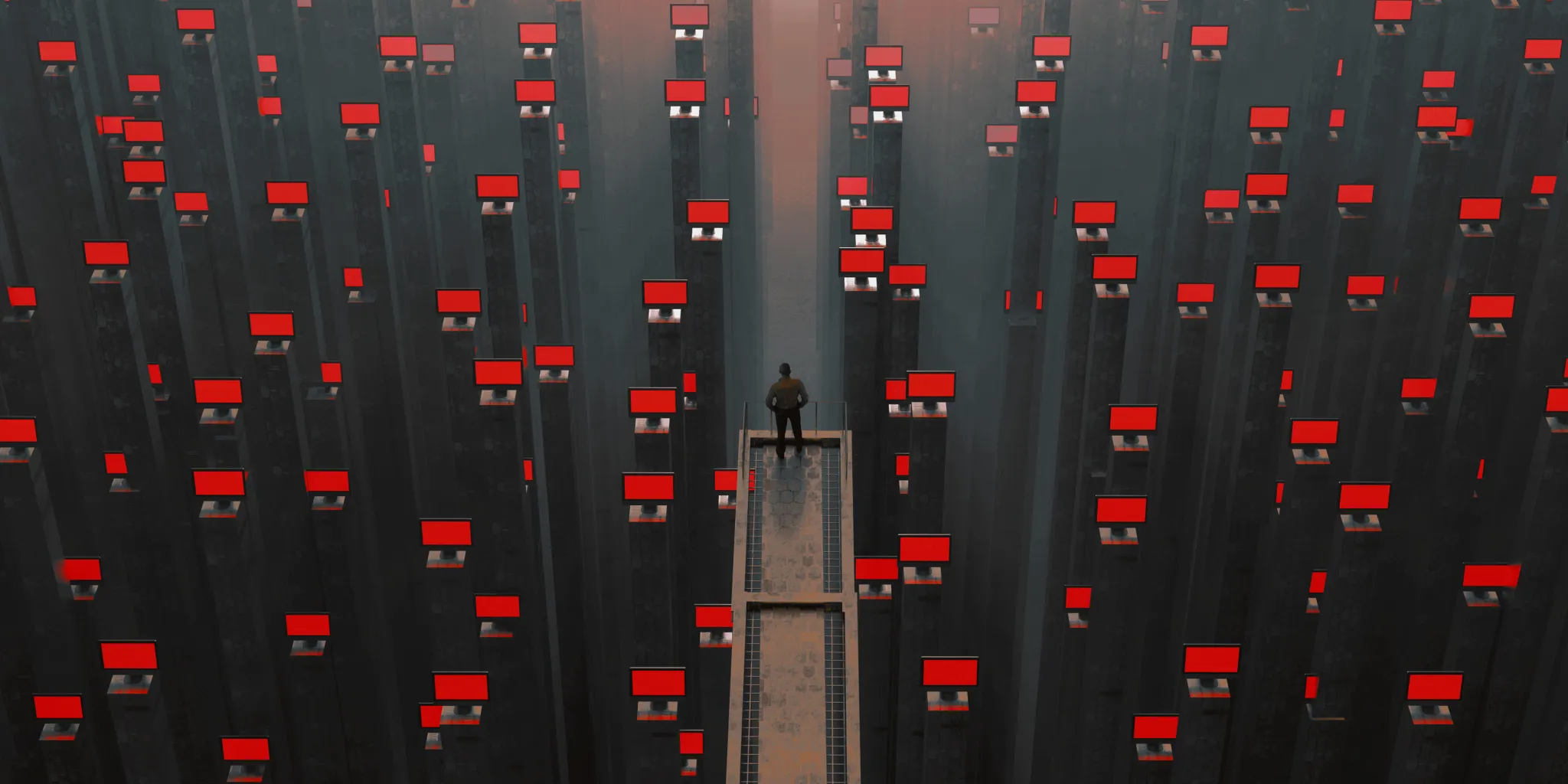
Between the hidden masterpieces of Bollywood cinema lies Vishal Bhardwaj’s Haider (2014). Set against the backdrop of a militarized Kashmir, the film depicts a harrowing image of psychological trauma—a trauma not merely born of physical violence, but one that is eventually caused by the constant, suffocating surveillance of power. In a pivotal scene, Roohdarr, a leading character played by Irrfan Khan, meets a man deeply affected by paranoia. In that moment, we realize that such mental instabilities are not just irrational clinical symptoms. On the contrary, the affected individual freezes and mistrusts their own reality precisely because of the chaotic, fear-filled environment shaped by invasion, occupation, and aggression. In this sense, paranoia is not a disorder of the individual mind, but an aftermath of Psychopolitics run by abusive power politics.
This cinematic image offers a crucial understanding of contemporary coloniality. It reveals that colonial power lives in our "psycho-sense" not only through the seizure of territory or the application of physical force, but through a surveillance apparatus that injects fear into everyday life. This turns our psychological states into tools of control. Beyond simple paranoia, an immense number of conditions—chronic anxiety, hypervigilance, dissociation, and emotional voidness—appear as psychic responses to prolonged exposure to surveillance and conflict. These are not ordinary clinical illnesses to be treated with medication; they are adaptive mental states in which individuals continuously anticipate danger, evaluate their behavior, and regulate themselves in order to survive the matrix of power politics. Through this article, I attempt to create a theoretical image of this phenomenon, tracing a lineage from Jeremy Bentham’s Panopticon to Michel Foucault’s disciplinary society, through Shoshana Zuboff’s surveillance capitalism and Byung-Chul Han’s psychopolitics, and finally arriving at a Khaldunian critique of the "fragility of Asabiyya" in the surveillance state.
The Panopticon makes every prisoner visible to a central watchtower, creating an asymmetry of visibility. Inmates cannot see the observer, so they adjust their behavior according to moral policing. Uncertain if they are being watched, they internalize discipline to survive. Foucault stated modern power relies on prejudicial memory from constant oppression. This marks a shift from public torture to the quiet, internalized discipline of the gaze.Surveillance shapes individuals to think, act, and understand themselves in specific ways. Clearly, it now works in the human psyche more than in mere political institutions, transforming from a prison management technique into a pervasive social problem.
However, this internalized memory brings with it the problems of hypervisibility and observer bias. When power is aligned with the majority's position, only minorities become accountable and visible. Meanwhile, the majority continues to perpetuate chaos under the guise of "The System." Hypervisibility is a troublesome state where the subjective bias of power dictates who is watched. In this sense, the minority falls victim to unwanted attention; they suppress their own behavior to avoid actions that might look suspicious, acting "appropriately" even when they are entirely alone. This induces a state where fear—an emotion that can destroy the symmetry of the human mind—plays a dominant role. More than traditional warfare, today's life is bombarded with the constant fear of being oppressed through this hypervisibility. While one could argue this develops "discipline," it is a discipline born of the perpetual continuation of oppression through the internalization and normalization of fear. In the contemporary scenario, entire regions are objectified through continuous surveillance via drones, satellites, biometric systems, and overflowing databases. Through this mockery of the population by capital power, the objectified subjects lead a life of "docile bodies." This is the normalization of discipline through Governmentality—that is, governing through self-conduct and self-regulation driven by repression and anxiety.
Surveillance Capitalism: The Commodification of Behavior.
Modernity's capitalist order has caused numerous blunders for humanity in the name of profit. From colonialism to war-capitalism, we have ample examples for analysis. However, in the 21st century, Shoshana Zuboff’s Surveillance Capitalism plays a major role. It is essential to understand surveillance at the anticipatory level of wars, politics, and economics. Zuboff notes human experience is now translated into databases. Data collected for "security" interrelates with the capitalist realm. Corporations analyze psychic states, creating "Constant Consumerism" through manipulation for profit. This extraction of "behavioral surplus" turns future actions into products for advertisers and political operatives. Fear plays an immense part in this bounded consumerism. Even when aware of data harvesting, subjects don't withdraw due to fear of exclusion or invisibility. When trends shift, users must align with capitalist desires to remain "seen". Subjects measure chances of social exclusion and imitate one another, never crossing neo-imperial boundaries. Here, visibility works contrary to the Panopticon. In Surveillance Capitalism, subjects are frantic about not being viewed. We have moved from the fear of being watched to the fear of disappearing.
Psychopolitics and the Pathological Self-Image.
In such a hegemony, life becomes rigid. The expansion of "pluriversality"—the existence of multiple ways of being—becomes impossible because basic ideological biases are inscribed onto the body through subjectivation and epidermalization (inferiority inscribed on the skin). When this psychic conflict occupies the mind of the colonized or the power-subject, they go through great measures of uncertainty and immense fear. This directs us to the leading cause of Psychopolitics. In the era of surveillance, psychopolitics is a critical mode for understanding contemporary society. Byung-Chul Han developed this theory to make us understand that power in this society no longer needs to impose itself on us externally. As Zuboff indicated, we are willingly participating in it. Our psychic values have turned into the victims of a "self-socialized gaze." We monitor ourselves, optimize our own deeds, and expose personal data in order to survive, succeed, and avoid failure. Han argues that we have moved from Foucault’s disciplinary society (of hospitals, madhouses, prisons, and factories) to an achievement society. The disciplinary society was negative; it said "No." The achievement society is positive; it says "Yes, we can." But this freedom is illusory. We are no longer exploited merely by external masters; we exploit ourselves in the belief that we are realizing ourselves. This dynamic takes a darker turn in conflict zones. When it comes to Palestine, the Middle East, or any other contemporary war-affected region, the subjects intensify monitoring themselves in order to survive misclassification. Since they must optimize and manage risks, they get disciplined not just through physical barriers, but through non-physical psychic activities—through the fear of inadequacy, invisibility, or falling behind.
This framework of surveillance allows us to understand that our identity is formed or entailed in aggression. Thus, psychic traumas and memories persist in a "positive" nature—meaning they are actively produced and maintained—because their basis is inducted through constant fear. The fear and anxiety have become so normalized that the subject's memory no longer exists independent of the trauma. After the era of classical colonialism, capitalism continued this "memory creation" within the framework of neo-imperial corporatism and surveillance. By the excess control of global metrics, we have arrived at a form of neo-slavery. Walter Mignolo’s concept of the coloniality of knowledge points out this kind of invisible power. It makes structural destruction easier because the "order" was taken over by colonizing the means of knowing itself. The erasure of memories from the psyche of the oppressed has already begun. The consequences are starting to manifest, resonating with Frantz Fanon's concept of psychic interiorization—a resonance of oppression against the self's subjectivity. The architecture of the Panopticon survives today through the self's obedience, manufactured through fear and the complex emotional imbalances that occurred with the "colonizing mind" project.
The Chilling Effect and Technofeudalism.
This creates the Chilling Effect, an important phenomenon where the span of attention is policed. Since global media has been taken over by corporate entities that exchange data with governments in the name of "Holy Security," every data profile—not just the inner human—fears expressing their points on social media. Basically, the chilling effect is an inner threat: a hesitation to react or comment on content for fear of misinterpretation, unnecessary hate, or state retaliation. A study based in the UK indicates that this process disproportionately affects minorities; as a power process, it is designed to be unequal. We are told we are free, politically liberated, and that our opinions matter. But in reality, our minds are stuck in a delusion of inferiority and numbness. The triad of the Panopticon, Surveillance Capitalism, and Psychopolitics adjacent creates this chilling effect, causing nightmares for subjects who have been objectified as "living dead bodies," as Achille Mbembe indicates in his theory of Necropolitics. Yanis Varoufakis’s concept of Technofeudalism re-emphasizes our argument with an irrefutable fact: Capitalism—which theoretically gave equal chances for everyone to gain profit—doesn't exist anymore. Those positions have been conquered by multi-tech billionaires. They rent out the "life of visibility," making platforms into large, bound farms, and turning ordinary citizens into "digital serfs". Varoufakis's statements are clear metaphors for our lifelong disaster: we are working the land of the cloud lords, producing data (crops) that we do not own, for a visibility we must pay for. Antoinette Rouvroy states something unexceptional relating to political deliberation and subjectivity: these are transforming into mere correlations and predictions. This ontologically violates human nature through modern, algorithmic, emotionally void surveillance. Such a mechanical treatment of human nature replaces the qualitative analysis of a scholar or a judge with statistically recorded algorithms that cannot understand the context or nature of incidents, eventually causing chains of tragedies. The evolution was simply from people as "subjects" to people as "predictions" of what will happen next. Through all these controversial commentaries, what we must extend is the realization that surveillance has made man a slave of invisible directions.
Islam, Decoloniality, and the Khaldunian Perspective.
Finally, we must look at the perceptions of surveillance victims through the lens of Ibn Khaldun’s power theory. Khaldun's understanding of the relation between Power, Subjects, and Objects has always held a top position through his concept of Asabiyya (group solidarity) and socio-economical theories. Khaldun stated that since Asabiyya is necessary for any rule, excess control is not a sign of a strong position of power, but rather a state of fearing the decay of neo-rule. When a dynasty is strong, it relies on natural solidarity; when it becomes senile and weak, it relies on walls, guards, and surveillance. Islam is an ideology heavily affected by colonialism and Islamophobia. Through decolonialism and intellectual Islamic resistance, Muslims are often the scene of revolution against a corrupt order. Therefore, the incoming awareness of this resistance can be viewed through Khaldun’s lens: the fragility of the ruler's Asabiyya leads to an excessive thirst to control subjects by creating psychic chaos through surveillance systems like the Panopticon. Khaldun extended his words by noting that power in the human mentality never becomes minimal; indeed, the desire for greater control, certainty, and predictability grows even further as power consolidates. To expand, rulers intrude upon and corrupt the population. A similar phenomenon is occurring in contemporary surveillance.
Conclusion: Actions Speak Louder.
In sum, surveillance is a profound matter to contemplate. Surveillance Capitalism is not just an economic issue but a deep psychic damage inflicted by the need to be visible. Psychopolitics is an unidentified, pervasive way of life. Neither "Technofeudals" nor the static state of AI do good to human nature. Contemplations and theoretical frameworks are not meant to brag, but to act. As everyone agrees, actions speak louder than words. We must recognize the invisible barricades of the mind and the chilling effects of the digital age to reclaim our subjectivity from the algorithmic void.