
Dr. Munkir Husain: The Revered Sufi Saint, Scientist, and Land Donor of the Darul Huda Bengal Campus
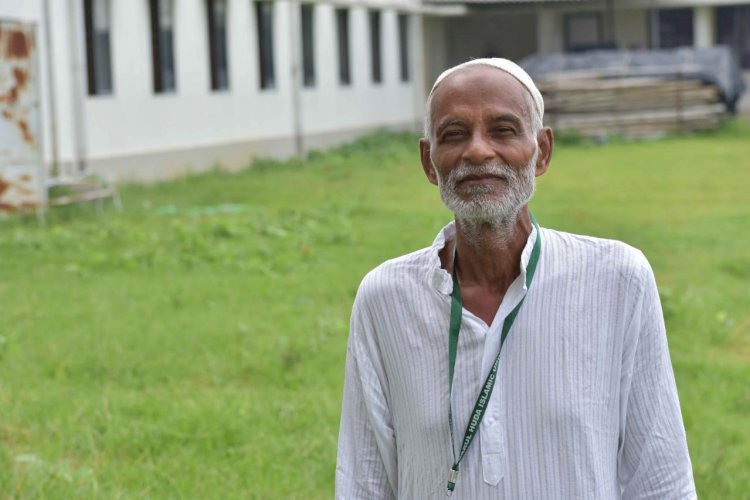
He was a personality whose thirst for religion and preaching could not be quenched, a distinguished figure whose presence no researcher could deny. He stands out as a remarkable individual in the lands of Bengal. Time is often miserly in producing the likes of such individuals, and history has recorded few examples like him. He contributed enduring efforts that encapsulate a great legacy, portraying the life of a pioneering scholar and preacher. He is none other than Dr. Sufi Munkir Husain.
When the people of Bengal lived under the shadows of poverty and famine, most could not afford to send their children to schools or colleges. But by the mercy of Allah, this land was destined to give birth to a guided son who would become a means of enlightening Bengal and rescuing it from the deprivation of Islamic education.
Dr. Munkir Husain was born on September 20, 1954, in the village of Khutkail, West Bengal. He played a significant role in advancing scientific research and Islamic education in India. He grew up in the village of Baikar (Bhimpur, Birbhum district). His father, Faiz Husain, was a poor farmer, and his mother, Rajia Bibi, was a homemaker.
A Childhood Etched in Memory
After his birth, Dr. Munkir Husain was raised by his grandparents due to the extreme poverty of his family. His father worked as a daily laborer in their village, earning very little, making it nearly impossible to provide a good education for his son. His grandmother, Sahiba Bibi, and his grandfather, Majid Sheikh, recognized the importance of education and took him to Bhimpur to ensure he had better learning opportunities.
At the age of 18 months, he moved in with his grandmother. By the age of four, he was enrolled in kindergarten. Throughout his school years, he assisted in tending sheep and cattle in the fields of his village, all the while dreaming of becoming a great scholar. However, the greatest obstacle he faced in pursuing his dream was his family’s dire poverty.
Dr. Munkir did not own a mobile phone and never sought fame or wealth. His sole ambition was to bring about real change in the lives of poor children, especially girls, by providing them with free education and essential facilities.
"Food is not my concern, but I do not want children to be deprived of their right to education because education is the only way out of poverty," he would say, while working on the land he rented in his village to grow vegetables and raise livestock.
From Theory to Practice: His Academic Journey
From an early age, Dr. Husain was keen on obtaining an education. According to his published biography, he received his primary and secondary education at Bhimpur School in Birbhum. He then continued at Nayagram Y.M. Junior High School and later at Baikar High School, completing his secondary education in 1973. He enrolled at Krishna Chandra College in Hetampur, Birbhum, where he earned a Bachelor of Science (B.Sc.) degree. He then pursued higher education at the University of Burdwan, obtaining a Master of Science (M.Sc.) and a Ph.D. in Chemistry.
After earning his doctorate, he continued his research as a postdoctoral fellow at the Indian Institute of Technology (IIT) Bombay for seven years before traveling to Japan, where he conducted research for two and a half years. Later, he joined Academia Sinica in Taiwan as a postdoctoral researcher from 1999 to 2016. During his career, he published over 55 research papers in prestigious international journals, in addition to seven national research papers.
His research focused on various topics in applied chemistry, with his last major project centering on activating chemical bonds using copper catalysis. His contributions led to numerous scientific innovations published in renowned journals such as the Journal of the American Chemical Society and Green Chemistry.
Educational Life and Social Services
Islamic education witnessed remarkable progress thanks to the efforts of Dr. Munkir Husain, who played a key role in establishing the Darul Huda Islamic University campus. This institution became a beacon of hope for those deprived of higher education, especially since students previously had to travel to distant places to pursue their studies.
In 2008, Dr. Munkir Husain acquired land in Bhimpur, Bengal, before moving to Kerala to further his educational projects in collaboration with Sheikh Baputi Haji (may Allah have mercy on him). He then founded the Sakina Foundation and the Darul Huda Islamic University campus, purchasing three acres of land to establish an educational institute for girls. He also supported the establishment of the Darul Uloom Al-Fawz Educational Center in Birbhum and was the main sponsor of the Darul Huda campus in Birbhum.
In 2011, he laid the foundation stone for the Darul Huda University campus in Bengal, followed by the women's university campus in 2021, reinforcing his commitment to women’s education and empowerment. His efforts extended further with the establishment of a hospital for mothers and infants, run by specialized female doctors, to serve underprivileged communities.
Thanks to his contributions, numerous educational and social institutions flourished, along with the expansion of mosques and schools that benefited the region's people. Some of his notable projects include:
- A dedicated women’s university within the campus.
- The construction of Darul Hasanah in Rampurhat for orphaned girls.
- The establishment of the largest mosque within the university campus.
- The creation of libraries, such as the Darul Fawz Library in Bhimpur, Ja'fariya School in Khutikul, and Muhammadiyah School in Ramjandrapur.