
The Trouble with Islam Today: A Critical Review of Irshad Manji’s Ideas of Non-Exclusionary Islam
The Trouble with Islam Today: A Critical Review of Irshad Manji’s Ideas of Non-Exclusionary Islam
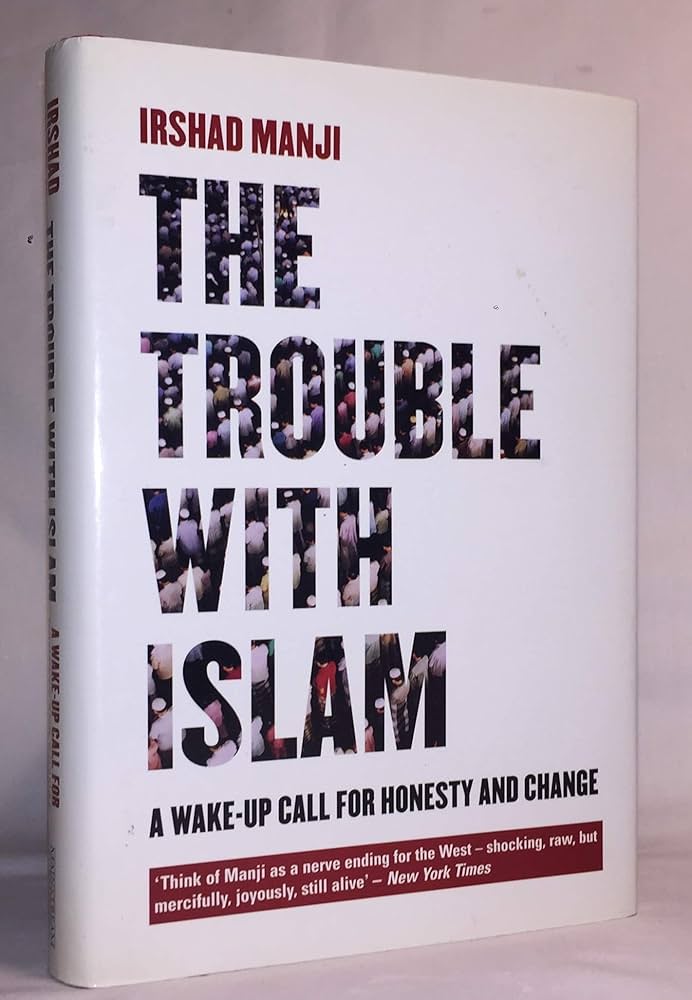
Irshad Manji is among those who immigrated from Islamic countries to the West, prompted by personal and family concerns arising from atrocities committed by their specific governments. She advocates for implementing modern ideologies within Islam, seeking to reform and rethink it toward a non-exclusionary model.
What exactly fuels her critique? Manji’s personal history explores the wide range of domestic violence and cruelties experienced under the government in Africa when it became the “land for Blakash” during the regime of Ibn Adani. Not surprisingly, like that of other Islamic critics, Irshad Manji’s critique is steeped in the same atmosphere and tragic background, aggravated by unremitting hostilities. These unanswered questions led her, and reduced her, to “her Islam,” which she mentions in the first part of her book as “my Islam,” signifying a mindset of rigidity and non-complexity.
In sharp contrast, there are individuals who reverted to Islam by asking challenging questions, such as Hamza Andreas Tzortzis. The unwillingness to accept anyone but the self drastically changed Manji toward rigidity. As she mentions regarding Kaki, her teacher in a Madrassa in Richmond, Canada, she never wanted to hear or listen to the instruction given even by the scholars.
In this context, a philosophical question spirals in my mind: If Islam is merely everyone’s personal opinion and individual explanation of Quranic verses and prophetic teachings, what would be the outcome if everyone began to act like a Kalir (a) and started killing innocent human beings with their own justification? This, explicitly, is the concern reflected in Irshad Manji’s work.
She addresses a rightful, and moreover, relevant question: Is it possible to be a Muslim woman and a feminist simultaneously? In general agreement, the blunt answer is yes. In reality, Islam seeks a woman's protection rather than the concept of freedom idealized by liberalism. Islam intends to convey the message of equity before equality, which could never be fully realized in a secular world for several reasons. In contrast, the modern liberal world order betrays women by condoning nudity for market values. Yet, the woman does not recognize this. Isn't this a form of suppression? Am I right?
The idea of Hijab and covering the body protects a woman from the ruthless acts of exploiters. Furthermore, the Quran has directed men to lower their gaze toward women. From a liberal perspective, this differs significantly from the Islamic view because Islam prioritizes rights and protection, while liberalism focuses on the ideal of freedom, regardless of the potential exploitation of the woman's body.
As an avowed lesbian, Irshad Manji sorely wants to justify the ideologies of LGBTQIA+ politics within Islamic tradition. Her question in the book is blunt and crystal clear: If everything created by God is excellent, then why do we exclude lesbians and gays? Aren’t they excellent in the eyes of God?
The Almighty God created only two genders, the male and the female, as clearly mentioned in the Quran. Historically, Almighty God dismantled the tribe of Lūṭ (Lot) because of homosexuality. The issue of lesbians and gays is often viewed as a mental illness that could be clinically overcome, as discovered by the famous scholar Jaims Caspian. If we were to accept them purely based on an emotional edge, what would we say about the existence of murderers? Are they not human beings? This world, however, has an order that cannot be disobeyed without causing a dangerous atmosphere. Matters related to intersex individuals are already addressed in books of Islamic jurisprudence, such as Khunthā al-mushkil and ghayr mushkil, and so on.
The feminist movement describes gender as a social creation, referring to one's internal self rather than accepting it based on genetic organs. There are many medical solutions to overcome mental illness in this world, and even within the framework of Islam. I choose not to delve further into the depth of this topic.
The next question in her book mentions a Nigerian girl who had been given 180 lashes for committing premarital sex while pregnant. Manji condemns this act by the Nigerian government.
While this specific deed may not be exactly what the Sharia directs, lashes for those who commit illicit sex are indeed a rule and punishment in Islamic Sharia (hadd). However, this requires clearance by four eyewitnesses who must have seen the act very clearly. Furthermore, in a case where a child is in the womb, the Sharia directs the punishment to be carried out after the delivery.
This is well-explained in the Hadith of the Prophet (PBUH). Imran ibn Husayn reported:
“A woman from the tribe of Juhaynah came to the Prophet ﷺ while she was pregnant from zina [fornication/adultery]. She said, ‘O Messenger of Allah, I have committed an offense requiring punishment, so carry out the sentence on me.’ The Prophet of Allah ﷺ called her guardian and said, ‘Treat her well. When she gives birth, bring her to me.’ Her guardian did as commanded. After she gave birth, the Prophet ﷺ ordered that her clothes be secured around her, and then she was punished by stoning. Afterwards, the Prophet ﷺ offered the funeral prayer for her.” (Ṣaḥīḥ Muslim, Hadith 1695).
Imam an-Nawawi (may Allah have mercy on him) explained in his commentary on Ṣaḥīḥ Muslim regarding the case of al-Ghamidiyyah, the woman who committed zina:
“The Prophet’s words ‘until you provide birth’ show that a pregnant woman must not be stoned before she delivers her child. Likewise, if she is unmarried, she must not be subjected to lashes until after the birth. The scholars are in unanimous agreement on this matter.”
Furthermore, the punishment is to be delayed not only until she gives birth but also until her child is either nursed by her or finds sufficient nourishment through the nursing of another woman.
This means when a woman bears a child, it is advised to delay the beating until after the delivery. In the modern secular world, however, these pregnancies are often violated, and the one responsible for the pregnancy lives his life ruthlessly and without consequence. However, these types of problems could be solved internally without needing a court judgment.
The next argument she mentions in her book is related to the Quran, claiming it should not be accepted blindly without any interpretation, and asserting it is not the final word of God in Islamic tradition. How can a professing Muslim make such an argument? May Allah forgive her.
The Quran and its verses are affirmed and explained by testimony, and it is clearly from the God in whom Irshad Manji believes. Then what is it in these verses that her adherents defend? Ironically, why she didn’t accept the prohibition of liwāṭ (sodomy) is a taboo, just like homosexuality. We can conclude that she cherry-picks what she wants to obey and fabricates what she does not want to be directed by God. In this scenario, she is being the god, and God is being her slave.
Not surprisingly, her next argument is that Muslims are attracted by terrorist ideas. She exemplifies this with the 9/11 incident, which is outdated and was openly condemned by mainstream Muslim scholars, such as Al-Azhar University, which published an open letter to the world against it.
My question is very clear: How can an intelligent person condemn the whole society based on the deeds of the minority, especially when those deeds are not accepted by the major religious sources? Does that make any sense?
Apparently, the history of the foundation of the terrorist groups leads back to the Soviet-Afghan War (1979-1989). At that time, America was a sworn enemy of the Soviet Union. To defeat the Soviets, America intruded by backing the extremism of the Afghan mujahideen. What happened next is clear: the U.S. backed these powers in the name of religion. And who backed Osama bin Laden to establish Al-Qaeda, the Muslim extremist group? It was America, without a doubt. And ironically, American troops later boasted of assassinating the very same Osama bin Laden. What a contradiction. It is foolish to ask what makes her prefer the West over others, and America in particular. In any case, the 9/11 chapter is closed.
Conclusion
In conclusion, Irshad Manji’s vision of a “non-exclusionary Islam” rests more on personal grievances and liberal ideology than on authentic Islamic sources. While her questions about gender, justice, and freedom resonate with contemporary debates, her answers often distort Islamic principles rather than engaging them faithfully. By confusing freedom with truth and self-expression with divine guidance, she risks replacing God’s authority with her own.