
The Cyrusian Plight: A Glimpse into Martyr!
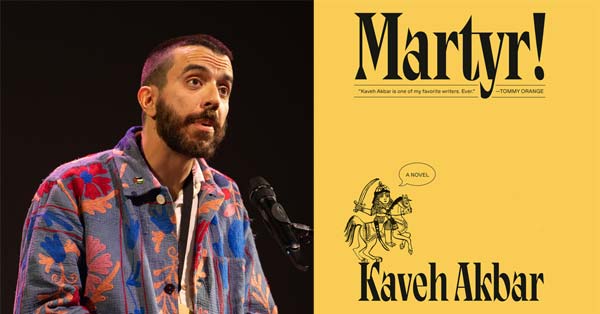
"He wanted his life to mean something, or failing that, he wanted his death to mean something."
To discern the life of Cyrus Shams is to take a retrospective glimpse into the nature of sobriety, a state which, paradoxically, propels Cyrus toward the pursuit of a "meaningful death." His struggle is not a spontaneous conception of existence but the holistic sum of his history: the quiet grief for his father, Ali, and the spectral haunting of his mother, Roya, whose civilian plane was shot down by the U.S. Navy in 1988.
As Cyrus journeys to Orkideh—an Iranian artist transforming her terminal cancer into a "living installation"—the narrative fills with a dialogue of spectral notions, interrogating the performance of identity. While drugs once offered a "false transcendence," sobriety strips away that armor, leaving only his fixation on martyrdom. The philosophical heart of the novel beats within these dual conversations, re-thinking the ingrained instincts that drive a person’s mental and spiritual course.
"History is a matter of who gets to tell the story, but grief is a matter of who has to live in it."
This inherited trauma articulates the heavy, specific weight of the immigrant experience. Akbar’s narrative demonstrates how displacement and war breed a profound disillusionment, coupled with incremental devastation and cultural isolation. These surreal conceptions evoke a Kierkegaardian absurdity, where reality is a tangle of imaginative coordinates and creative paranoia.
Throughout the odyssey, Cyrus is presented as a "suicidal person who doesn’t want to die"—one who lacks the tools to navigate the mundane. He views martyrdom as a noble aperture through which he can inject meaning into a spiraling existence. Ultimately, however, he interiorizes the psychic reality: his obsession was merely a distraction, a way of avoiding the quintessence of living.
The haunting memory, once realized, is not a horrific flash into his nous, but a means of harking back to the hidden chronicles and forgotten dimensions residing silently within him. Navigating this vacillating tapestry, Cyrus serves as a periscopic instrument for the author to foreground the Pessoan side of humanity—the part of us that strides toward existential anxiety, echoing the cry: "I don’t want to be, I don’t want to die, but I want the third thing."
Akbar apprehends art as the ultimate survival mechanism—a manifestation of the ineffable that defies logic. It provokes a disinterested pleasure that transcends utility by conveying "impossible" truths. Ultimately, Martyr! is its own artistic rendition of this truth, precisely blending the incommunicability of emptiness with the shimmering mirage of a meaningful death.